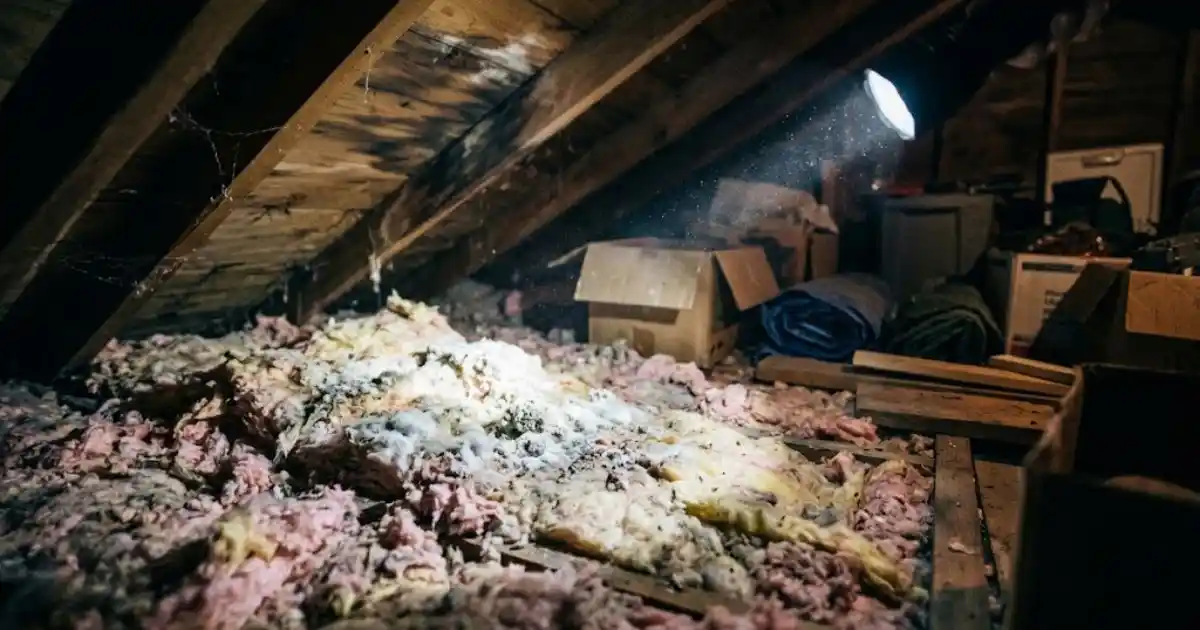
Attic mold is one of the easiest problems to miss for months, since most people rarely go into their attic, and a slow roof leak can feed mold growth quietly the whole time.
Signs You Can Notice Without Going Into the Attic
A musty smell in an upper-floor hallway or closet, especially one that's stronger after rain, is one of the more reliable early signs. A ceiling stain on the top floor, even a faint one, is worth checking directly rather than assuming it's just old. Some homeowners also notice a slight temperature or humidity difference in rooms directly below the attic during humid weather.
Another sign worth watching for is a shift in how quickly an upstairs room feels stuffy or humid compared to how it used to, since compromised attic insulation from sustained moisture loses some of its performance even before visible mold or staining develops. That kind of gradual comfort change is easy to attribute to the HVAC system or the season rather than the attic above, which is part of why it goes unaddressed for so long.
Why Roof Leaks Feed Attic Mold So Effectively
A roof leak drips onto attic insulation and decking, both of which hold moisture far longer than a hard surface would. Combined with typically poor attic ventilation, especially in older homes, that moisture has ideal conditions to support mold growth for months before it becomes visible from the living space below.
The insulation itself compounds the problem once it's wet, since damp insulation loses much of its ability to regulate temperature and humidity, which can create a feedback loop where the attic space stays more humid than it would with dry, properly functioning insulation. That extra ambient humidity then supports continued mold growth even after the original leak source is addressed, unless the wet insulation itself is also replaced.
A Real, Specific Complication: Animal Contamination
In wooded parts of Winder, particularly near Fort Yargo and similar tree-covered areas, bird droppings entering through a roof gap can combine with existing moisture to create both a contamination issue and a mold risk at the same time. This is a genuinely distinct scenario from a simple roof leak, since it needs safe contamination cleanup alongside standard mold remediation, not just one or the other.
Fort Yargo, originally built in 1793 and now a state park, sits close enough to several residential areas that homes near its wooded perimeter see a real, practical uptick in this combined roof-gap-and-wildlife scenario compared to homes in a more open, less tree-covered part of Winder. It's a specific enough pattern that we factor proximity to heavily wooded areas into how we scope an attic inspection.
What an Inspection Actually Checks
An attic mold inspection looks at insulation condition, roof decking, ventilation adequacy, and any signs of animal entry points, not just the presence of visible mold. This gives a full picture of both the mold itself and what's likely feeding it, since removing mold without fixing the roof leak or ventilation gap behind it just resets the clock on the same problem.
Why Ventilation Gets Overlooked So Often
Many homeowners focus entirely on finding and fixing the visible leak while overlooking attic ventilation as a contributing factor, even though poor ventilation alone can create enough trapped humidity to support mold growth without any active leak at all. Ridge vents, soffit vents, and attic fans, when present, all play a role in keeping attic humidity at a level that doesn't favor mold growth, and a ventilation problem can undermine an otherwise successful roof repair.
This is why a thorough attic assessment looks at ventilation as its own line item, separate from whatever roof leak prompted the inspection in the first place. A home can have a perfectly repaired roof and still see recurring attic mold if the underlying ventilation issue that made the attic vulnerable in the first place was never addressed alongside the leak itself.
What to Expect From the Remediation Process
Once an inspection confirms attic mold and identifies its cause, remediation typically involves removing affected insulation, treating exposed wood surfaces according to industry-standard practices, and confirming the moisture source is fully resolved before any new insulation goes back in. Skipping the confirmation step and reinsulating too early risks trapping residual moisture against new material, which can restart the same problem within the new insulation itself.
Can Poor Attic Ventilation Cause Mold Even Without a Roof Leak?
Yes, sustained trapped humidity from inadequate ventilation alone can support mold growth over time, which is why ventilation is checked as part of a thorough inspection even when a leak is the initial concern. A home with excellent roofing but poor ridge or soffit ventilation can still develop attic mold purely from humid Georgia air getting trapped with nowhere to escape, especially during long stretches of summer humidity when the attic space naturally runs hotter and damper than the living space below it. Balanced intake and exhaust ventilation, soffit vents pulling air in and a ridge or gable vent letting it out, is what actually regulates that humidity, and a home missing one half of that balance often runs damp regardless of how sound the roofing itself is. A quick visual check of soffit vents from outside for blockage by paint, insulation, or debris is a simple homeowner-level step worth doing before assuming a ventilation problem needs a professional diagnosis.
Dealing With This Right Now?
Call for same-day dispatch in Winder and Barrow County.
Common Questions
Not necessarily as a first step. The signs listed above, from inside the living space, are a reasonable first check, though a direct inspection is the only way to confirm what's actually happening.
Yes. Bird or animal contamination needs its own safe cleanup process in addition to standard mold remediation, since the two issues, while related, require different handling.
There's no fixed universal schedule, but after any significant storm, or roughly once a year for a wooded-area property, is a reasonable practical habit given the added exposure to both leaks and wildlife entry points.
Yes, sustained trapped humidity from inadequate ventilation alone can support mold growth over time, which is why ventilation is checked as part of a thorough inspection even when a leak is the initial concern.
If you're dealing with this in Winder, our Attic Mold Removal page covers the full process, and we also cover Dacula on regular dispatch.
Have Damage That Needs Attention?
Call now for emergency dispatch anywhere in Winder and Barrow County.
☎ Call (678) 798-8530