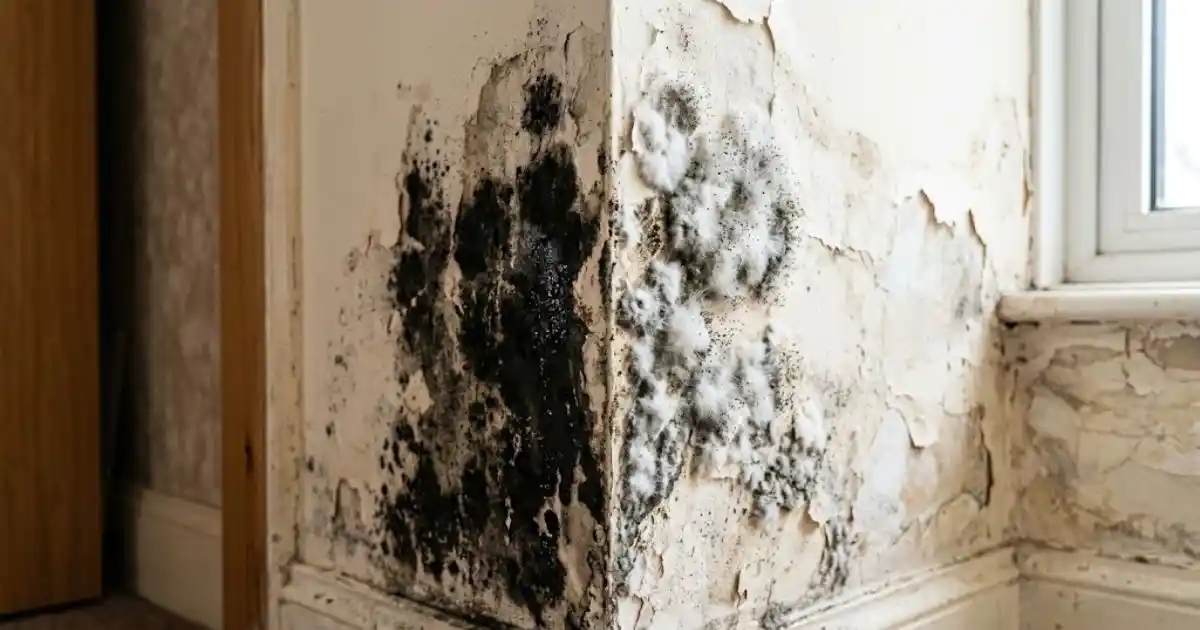
Dark-colored mold gets more attention than any other kind, and understandably so, but the honest picture is more nuanced than the color alone suggests.
Color Alone Doesn't Tell You the Species
Mold color depends on the species and the surface it's growing on, and dark coloration doesn't reliably indicate which specific mold is present without lab testing. Several common household molds can appear dark or black-ish, so visual identification alone is a starting point, not a diagnosis.
This is worth repeating because so much of the public conversation around mold treats 'black mold' as a single, specific, uniquely dangerous species, when in practice it's a color description that several distinct species can share. A homeowner trying to self-diagnose from photos or search results is working with less information than a direct inspection would provide, since surface texture, growth pattern, and moisture source all matter more than color for scoping the actual remediation work.
What Tends to Correlate With Darker Mold
Darker coloration is more commonly associated with prolonged, undisturbed moisture exposure, chronic basement dampness, a leak that ran for weeks before discovery, or water damage that wasn't fully dried the first time around. This doesn't mean every case of dark mold has been present for a long time, but it's a real, observed pattern worth factoring into how thorough an inspection should be.
That correlation is genuinely useful information for us during an inspection, since it points toward checking for a longer-running or previously unaddressed moisture issue rather than a single recent event. It changes where we look and what we test, even though it doesn't change the fundamental removal approach once the growth and its source are identified.
Why Removal Follows the Same Process Either Way
Regardless of color, mold removal follows the same core steps: identify and correct the moisture source, contain the area to prevent spore spread, and remove or clean affected materials based on how porous they are. We don't treat dark mold with a fundamentally different removal process, since the safe handling practices apply across mold types generally.
Where the process can differ is scope, not method, since a chronic, longer-running moisture issue often means a larger affected area than a mold problem caught early. That's a function of how long the underlying moisture went unaddressed, not a function of the mold's color requiring different removal techniques.
What We Won't Do: Make Health Claims We Can't Back Up
We don't make specific claims about individual health effects from mold exposure, since that's genuinely a conversation for a physician, not a restoration company. What we can do is assess the visible growth, identify the moisture source, and scope a removal plan honestly, without exaggerating risk to create urgency that isn't backed by evidence.
Why We Recommend Caution Over Alarm
A lot of mold marketing leans heavily on fear, using dramatic language about specific dark mold species to push urgent, high-priced remediation. Our approach is the opposite: identify what's actually growing and why, explain the real, practical risk in plain terms, and scope a removal plan sized to the actual problem rather than the scariest possible interpretation of it. Overstating risk to create urgency isn't something we consider good business, even if it's a common practice in this industry.
This means our written assessments describe what we observed, moisture readings, growth pattern, likely source, in factual terms rather than alarming language designed to pressure a decision. If a situation genuinely warrants urgency, because of active moisture, spread pattern, or affected material type, that urgency comes through in the specifics of the assessment itself, not through dramatic framing layered on top of it.
When Testing Genuinely Adds Value
Lab testing to identify a specific mold species is occasionally useful, mainly for insurance documentation, real estate transactions, or cases where a physician has specifically requested species identification as part of evaluating a health concern. Outside those specific situations, the practical remediation steps are largely the same regardless of which species is confirmed, which is why we don't push testing as a default add-on for every job.
Why Do Some Companies Charge More Just for 'Black Mold' Removal?
Some companies use the term as a pricing lever tied to fear rather than an actual difference in required work. The real cost driver is the size of the affected area, the moisture source, and how porous the affected materials are, not the mold's color. If a quote seems disproportionately higher purely because a technician used the words 'black mold' during an assessment, it's worth asking directly what specific additional work, if any, that label is actually adding to the scope, since a fair answer should point to concrete tasks, not just the color itself.
How a Fair Assessment Explains Cost Instead of Just Color
A trustworthy written assessment should explain cost in terms of square footage affected, material type, and containment requirements, the actual cost drivers, rather than simply noting the mold appeared dark and pricing from there. If two assessments for a similar-looking problem come back with very different prices and only one clearly explains its reasoning in those concrete terms, that's a useful signal about which one to trust more. Asking directly for that breakdown before agreeing to a scope of work is a reasonable, fair question for any homeowner to ask, regardless of which company they're considering. A company confident in its own pricing should have no trouble answering that question clearly, directly, and without any hesitation whatsoever, since transparent, itemized pricing is a basic expectation, not a special favor a customer has to ask for.
Dealing With This Right Now?
Call for same-day dispatch in Winder and Barrow County.
Common Questions
For a small, clearly-sourced patch, testing often isn't necessary to proceed with remediation. For a larger or unclear situation, testing can help confirm species and inform scope.
Spread rate depends more on available moisture and airflow conditions than on color specifically, which is why addressing the moisture source matters more than the mold's appearance.
Not if the underlying moisture source was actually identified and corrected. Recurrence usually means the source wasn't fully addressed the first time, not that dark mold is inherently more likely to return.
Some companies use the term as a pricing lever tied to fear rather than an actual difference in required work. The real cost driver is the size of the affected area and the moisture source, not the mold's color.
If you're dealing with this in Winder, our Black Mold Removal page covers the full process, and we also cover Dacula on regular dispatch.
Have Damage That Needs Attention?
Call now for emergency dispatch anywhere in Winder and Barrow County.
☎ Call (678) 798-8530