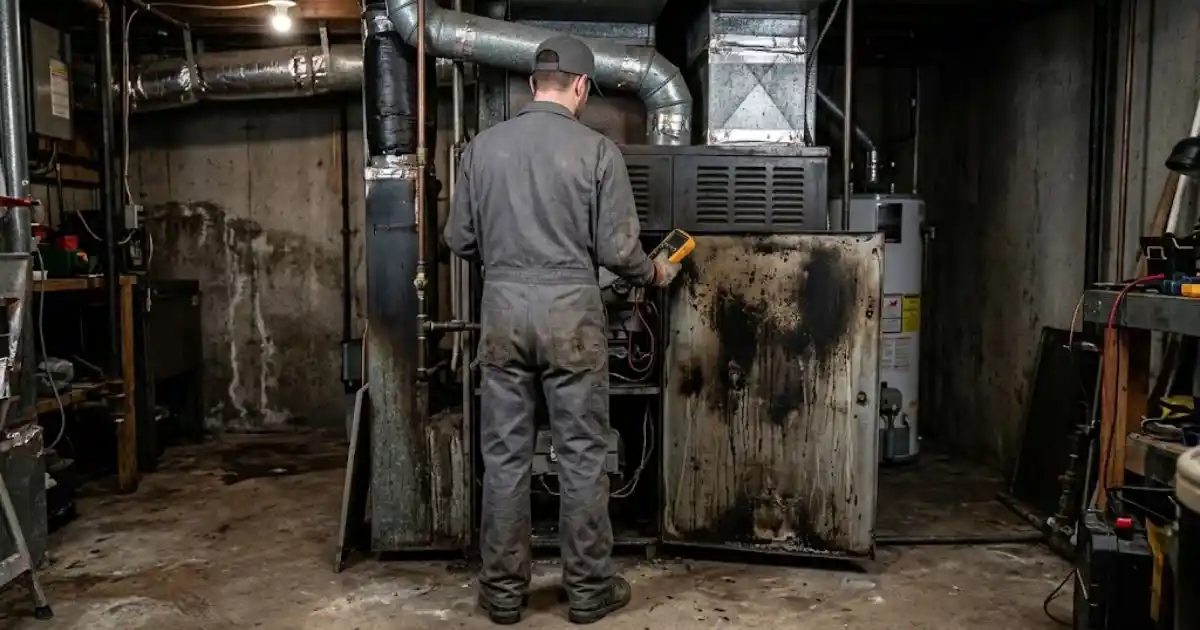
If you've come home to a fine, oily soot coating every room and traced it back to the furnace, you've likely experienced a puffback, a small, contained explosion inside the combustion chamber that forces soot backward through the ductwork instead of up the flue.
What Actually Happens During a Puffback
A puffback occurs when fuel oil or gas fails to ignite immediately as intended, allowing unburned fuel to build up in the combustion chamber. When ignition finally occurs, it ignites that accumulated fuel all at once rather than in a controlled burn, and the resulting pressure forces soot backward through the system's ductwork instead of exiting normally through the flue.
The event itself typically happens in a fraction of a second and is often loud enough that homeowners hear a distinct bang from the furnace room, even if they don't immediately connect that sound to the soot they later find throughout the house. That disconnect between hearing the event and discovering the full extent of the soot spread is part of why puffback damage sometimes isn't addressed until hours or even a day after it actually happened.
Common Causes Behind the Delayed Ignition
Dirty or clogged burner components disrupt normal combustion timing, a common cause in furnaces that haven't had recent maintenance. Faulty ignition or fuel system components, more likely in older furnace units, are another frequent root cause. A partially blocked flue can also force combustion gases backward instead of outside, contributing to the same result.
Regular annual furnace maintenance is the most direct way to catch these issues before they cause a puffback, since a technician checking burner cleanliness and ignition components during routine service is specifically looking for the conditions that lead to delayed ignition. Skipping that maintenance for multiple years is one of the more consistent patterns behind the puffback calls we respond to.
Why It Spreads to Every Room So Fast
Once soot is forced into the ductwork, the home's own HVAC system does the rest of the distribution work, carrying fine particles to every room the furnace serves within seconds. This is why puffback cleanup almost always covers the whole home rather than just the furnace room, even when the event itself happened in one contained space.
This is also why we always recommend a full-home assessment rather than just cleaning the visibly affected rooms, since soot travels through ductwork into rooms that might not show obvious surface staining right away but still have fine particulate settled on surfaces, inside vents, and within the HVAC system itself. Addressing only the visible rooms typically means recontamination once the system runs again.
Why Furnace Age Matters
Older homes near Winder's historic downtown, some with original or long-serving furnace equipment, see a real, higher rate of puffback events than newer systems with modern ignition safety controls designed specifically to prevent delayed ignition. If a puffback happens once, having the furnace inspected before restarting it matters, since running the same system again without addressing the cause risks a repeat event that would undo any cleanup already done.
What the Cleanup Process Actually Involves
Puffback cleanup starts with a full assessment of soot spread throughout the home, since the visible soot in the furnace room is rarely the full extent of the problem. HVAC ductwork typically needs cleaning as part of the same job, along with surfaces, textiles, and any HVAC filters throughout the home that were exposed to circulated soot during the event.
Specialized cleaning agents formulated for oily soot residue are used rather than general household cleaners, since standard cleaners can smear the fine, oily particles deeper into fabric and painted surfaces instead of lifting them off cleanly. This is part of why professional puffback cleanup, while it can feel like an involved process for what started as a furnace issue, produces meaningfully better results than DIY attempts with household products.
Coordinating With Your HVAC Technician
Since a puffback points to a combustion system issue, we typically recommend having an HVAC technician inspect and service the furnace before it's used again, in parallel with or shortly after cleanup. Addressing both the cleanup and the underlying mechanical cause together is the only way to be confident the same event won't recur the next time the furnace cycles on.
Should I Have My Furnace Serviced Every Year to Prevent This?
Annual furnace maintenance is a reasonable, genuinely useful preventive step, since a technician checking burner components and ignition systems is specifically looking for the conditions that lead to a puffback. This service typically costs far less than a single puffback cleanup, which makes it one of the more cost-effective preventive habits a homeowner with an oil or gas furnace can adopt, particularly for older systems that haven't had consistent annual service in the past.
What to Watch For Once the Furnace Is Back in Service
After a puffback is cleaned up and the furnace is serviced, keeping an eye out for any unusual smell, sound, or soot residue during the first several heating cycles is a reasonable precaution, since it confirms the underlying cause was actually resolved rather than temporarily masked. Any recurrence, even a minor one, is worth reporting back to your HVAC technician promptly rather than waiting to see if it happens again, since a second event usually means the original underlying cause wasn't fully corrected the first time. Catching that early, rather than living with an intermittent recurring issue, saves both further cleanup cost and repeated disruption to the household during the coldest part of the winter heating season overall, when a broken furnace is the hardest thing to be without.
Dealing With This Right Now?
Call for same-day dispatch in Winder and Barrow County.
Common Questions
We don't recommend it. Standard cleaners often smear the oily residue deeper into surfaces rather than lifting it off, making professional cleanup more difficult afterward.
Beyond the mess, a puffback indicates a combustion system issue that should be inspected before the furnace is used again, since it points to something not functioning as designed.
Yes, typically. Soot settles inside the ductwork itself, and running the furnace again without addressing that can recontaminate rooms that were already cleaned.
Annual furnace maintenance is a reasonable, genuinely useful preventive step, since a technician checking burner components and ignition systems is specifically looking for the conditions that lead to a puffback.
If you're dealing with this in Winder, our Puffback Cleanup page covers the full process, and we also cover Braselton on regular dispatch.
Have Damage That Needs Attention?
Call now for emergency dispatch anywhere in Winder and Barrow County.
☎ Call (678) 798-8530