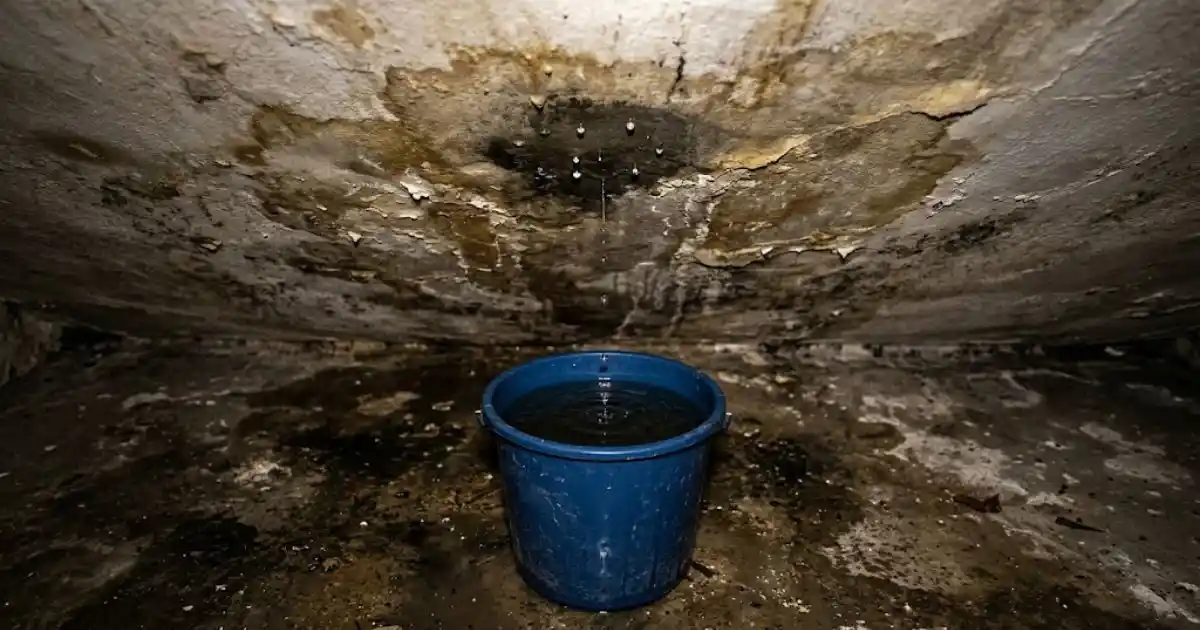
This is one of the most urgent calls we get, and for good reason: an active roof leak dripping into a ceiling can go from a small stain to a real structural problem within hours, especially during a Georgia storm system.
First, Contain What You Can Safely
Place a bucket or container under the active drip, and move furniture, electronics, or anything valuable out of the drip zone. If the ceiling has a visible bulge from trapped water, that's a sign of a larger pooled area above the drywall, and it's often safer to relieve that pressure with a small, controlled hole than to let the ceiling collapse on its own, though this step is safest left to a crew if you're not confident doing it yourself.
If you do decide to relieve a bulge yourself, use something like a screwdriver poked through the center of the bulge from below, with a bucket positioned directly underneath before you puncture it. The goal is controlling where and how the water comes down, since an uncontrolled ceiling failure spreads water, insulation, and drywall debris across a much wider area of the room than a single targeted release point would.
Don't Go Into the Attic During Active Rain
It's tempting to want to see the source directly, but attic spaces during active rain can be genuinely dangerous, wet insulation hides where solid framing actually is, and roof decking can be compromised right where the leak is worst. This assessment is safer done by a crew with the right equipment once conditions allow.
Beyond the fall risk, walking on wet insulation in an active leak area can also spread contamination and compress insulation in ways that make it less effective even after it dries, adding an unnecessary secondary problem on top of the leak itself. Waiting until the rain stops, or leaving that inspection to a crew with proper footing equipment, is the safer call in almost every case.
Why the Source Matters for the Fix
A ceiling leak can come from a roof failure, but it can also come from an upstairs bathroom or an upstairs closet ceiling leak, both of which are separate, real, common causes we see regularly. The fix is different depending on which it is, so part of the initial assessment is tracing the water's actual path rather than assuming the roof is always the source just because the damage shows up on the ceiling.
This matters practically because a roof-sourced leak needs a roofer involved for the actual repair, while a plumbing-sourced leak needs a plumber, and confusing the two means paying for a roof repair that doesn't stop a leak that was never coming from the roof in the first place. Tracing the path correctly the first time avoids that costly misdiagnosis.
What Happens Once a Crew Arrives
The visible stain is usually smaller than the actual wet area above it, so assessment includes checking how far the water traveled into insulation and framing, not just patching the ceiling itself. Wet insulation is typically removed since it holds moisture and can't be reliably dried in place, and drywall repair follows once the space above it is confirmed dry.
What to Expect for Timeline and Repairs
Once the wet area is confirmed dry, typically after a few days of monitored drying with air movers and dehumidifiers in place, drywall repair and repainting can begin. The exact timeline depends on how large an area was affected and whether any structural framing needs to fully dry before repair work starts, since closing up a ceiling over framing that isn't fully dry risks trapping moisture and creating a mold problem behind the new drywall.
It's worth setting realistic expectations here rather than assuming a ceiling leak is a same-day fix. The drying phase genuinely needs to run its course before cosmetic repair starts, and rushing that step to close up the ceiling faster usually costs more in the long run if it results in a hidden moisture problem discovered months later.
Preventing a Repeat Event on the Same Roof
If a roof leak was the actual source, coordinating with a roofer to address the underlying roof issue, not just the interior ceiling damage, matters for preventing the same event from happening again during the next significant rain. We can flag the likely leak entry point based on the interior damage pattern, which gives a roofer a useful starting point rather than searching the entire roof surface from scratch.
How Long Does the Ceiling Area Typically Need to Dry Before Repair Starts?
It varies by how much moisture reached the framing and insulation, but a few days of active monitored drying is typical before repair work can safely begin. Rushing this step to get the ceiling closed up faster risks trapping residual moisture behind new drywall, which can lead to a hidden mold problem discovered months later, well after the original leak felt fully resolved. A crew confirming dryness with moisture meter readings, not just a visual check, is what actually justifies moving forward with drywall repair rather than guessing based on how the space feels or smells at that point. That objective confirmation step is what actually protects against a repair that looks fine today but hides a moisture problem inside the wall assembly for months afterward, unnoticed, until it resurfaces as a much larger and more expensive repair down the road.
Dealing With This Right Now?
Call for same-day dispatch in Winder and Barrow County.
Common Questions
It can be done safely with the right approach, a small controlled hole with a bucket underneath, but if you're not confident, it's a reasonable thing to leave for a crew rather than risk a larger collapse.
Often the interior water damage and the roof repair itself are handled separately, sometimes by different contractors, so documentation of both is useful for whichever claims process applies.
We trace visible staining patterns, check moisture readings at different points along the ceiling, and look at what's directly above the affected area, since a bathroom leak and a roof leak usually show a different spread pattern.
It varies by how much moisture reached the framing and insulation, but a few days of active monitored drying is typical before repair work can safely begin.
If you're dealing with this in Winder, our Ceiling Water Damage Repair page covers the full process, and we also cover Braselton on regular dispatch.
Have Damage That Needs Attention?
Call now for emergency dispatch anywhere in Winder and Barrow County.
☎ Call (678) 798-8530