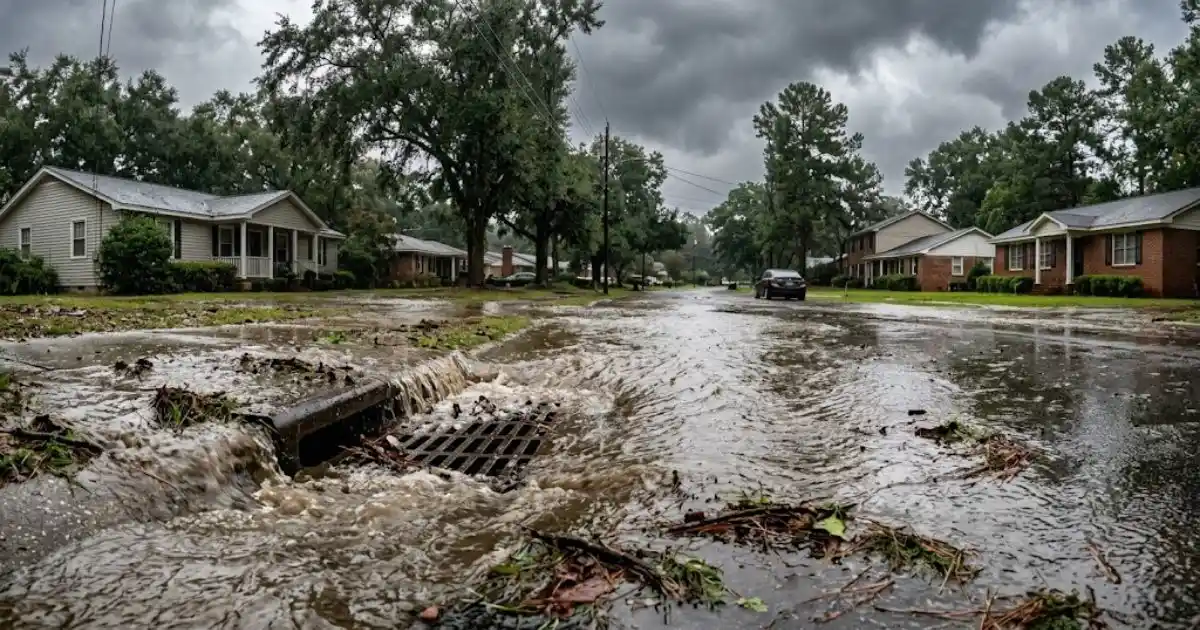
If a sewage backup in your home seems to happen right after a big storm, that's not a coincidence. There's a real, documented connection between heavy rain and backup risk that's worth understanding, especially in parts of Barrow County.
The Real Connection Between Storms and Backups
Barrow County's own floodplain program shows that certain low-lying areas see recurring stormwater accumulation during heavy rain. Those same conditions can strain both septic systems and shared municipal sewer capacity at once, which is why sewage backup calls in Winder tend to cluster around the same storm events that cause general flooding rather than showing up as isolated plumbing failures throughout the year.
This clustering pattern is genuinely useful for us operationally, since it means we can reasonably anticipate a spike in sewage-related calls during and immediately after a significant regional storm, rather than treating each call as an unrelated, isolated event. It also means a homeowner who's never had a backup before shouldn't assume their plumbing is at fault just because a backup happened during a storm large enough to affect the wider area.
Why Septic Systems Are Especially Vulnerable
A septic system relies on the surrounding soil to absorb and process wastewater over time. When heavy rain saturates that soil, the drain field can't process normally, and the system backs up toward the path of least resistance, usually the home's lowest drains. This is a real, physical limitation of septic systems generally, not a sign of a poorly maintained system, though maintenance issues can make it worse.
A septic system that's already near its service capacity, or one whose drain field has been slowly losing absorption efficiency over the years, will typically show storm-related backup symptoms earlier and more severely than a newer, well-maintained system facing the same rain event. That's worth knowing if your property's septic system is older, since it may be worth a proactive inspection before the next heavy storm season rather than after the first backup.
Municipal System Surcharge Works Similarly
For homes on municipal sewer service, heavy regional rainfall can overload shared system capacity, especially in older infrastructure, forcing backups into connections at lower elevations. This is a documented pattern in many municipal systems generally, and it means a backup during a storm isn't necessarily about your specific home's plumbing at all.
In practice, this means two neighboring homes can experience very different outcomes during the same storm depending on their elevation relative to the shared municipal line, even when both have equally sound internal plumbing. A home at a lower point in the local sewer network is structurally more exposed to this kind of surcharge backup regardless of how well its own pipes are maintained.
What to Do During and After
Stop all household water use immediately if a backup starts during a storm, since more water only worsens it. Once the storm passes and the backup is addressed, it's worth having both the cleanup handled professionally, given the health risk of contaminated water, and a separate conversation with a plumber or septic service about whether the underlying capacity issue needs addressing to prevent recurrence.
Why Sewage Cleanup Isn't a DIY Job
Sewage-contaminated water carries real health risks that clean floodwater doesn't, which is why sewage backup cleanup follows a different, more involved process than standard water extraction. Affected porous materials, carpet, some drywall, insulation, generally can't be safely cleaned and dried in place the way clean water damage can, and instead need to be removed and replaced as part of a responsible cleanup process.
Beyond material removal, thorough sanitizing of the affected area is a necessary step that a standard household cleaning approach doesn't achieve, since the goal is addressing pathogens that can remain even after visible water is gone. This is part of why we treat sewage backup calls as a distinct category of response rather than a standard water damage job with extra steps tacked on.
A Practical Note on Prevention
For homes with a documented history of storm-related backups, a backwater prevention valve is a commonly recommended plumbing addition that can meaningfully reduce recurrence by preventing sewage from flowing back into the home during a municipal system surcharge event. This is a plumbing installation outside what a restoration response covers directly, but it's worth raising with a licensed plumber if your property has seen more than one storm-related backup.
Can I Clean Up a Small Sewage Backup Myself If It's Contained Quickly?
Even a small, quickly contained backup carries contamination risk, so professional cleanup with proper sanitizing is the safer approach rather than treating it like a typical household spill. The health risk from sewage-contact materials doesn't scale down proportionally with the volume of water involved, which is part of why we recommend professional handling even for backups that seem minor at first glance.
A Note on Homes With a Recent History of Multiple Backups
If your property has seen more than one storm-related backup within a year or two, that repetition is worth treating as a signal rather than bad luck, since it usually means the underlying capacity issue, septic or municipal, hasn't actually been resolved between events. A conversation with a plumber or septic service specifically about capacity, not just clearing the immediate blockage, is the more useful next step at that point, since clearing a blockage without addressing capacity just resets the clock until the next comparable storm. That extra conversation is a small effort relative to another full cleanup.
Dealing With This Right Now?
Call for same-day dispatch in Winder and Barrow County.
Common Questions
Not necessarily every time, but if it's happened once during a heavy rain event, the underlying capacity issue is worth investigating rather than assuming it was a one-time fluke.
We assess where the backup originates in the home to give you a starting point, though confirming the septic system's specific condition is usually a separate septic service inspection.
For a property with a documented pattern of storm-related backups, a backup-prevention valve is a common recommendation from plumbers, though that installation itself is outside what a restoration response covers directly.
Even a small, quickly contained backup carries contamination risk, so professional cleanup with proper sanitizing is the safer approach rather than treating it like a typical household spill.
If you're dealing with this in Winder, our Sewage Backup Cleanup page covers the full process, and we also cover Loganville on regular dispatch.
Have Damage That Needs Attention?
Call now for emergency dispatch anywhere in Winder and Barrow County.
☎ Call (678) 798-8530